

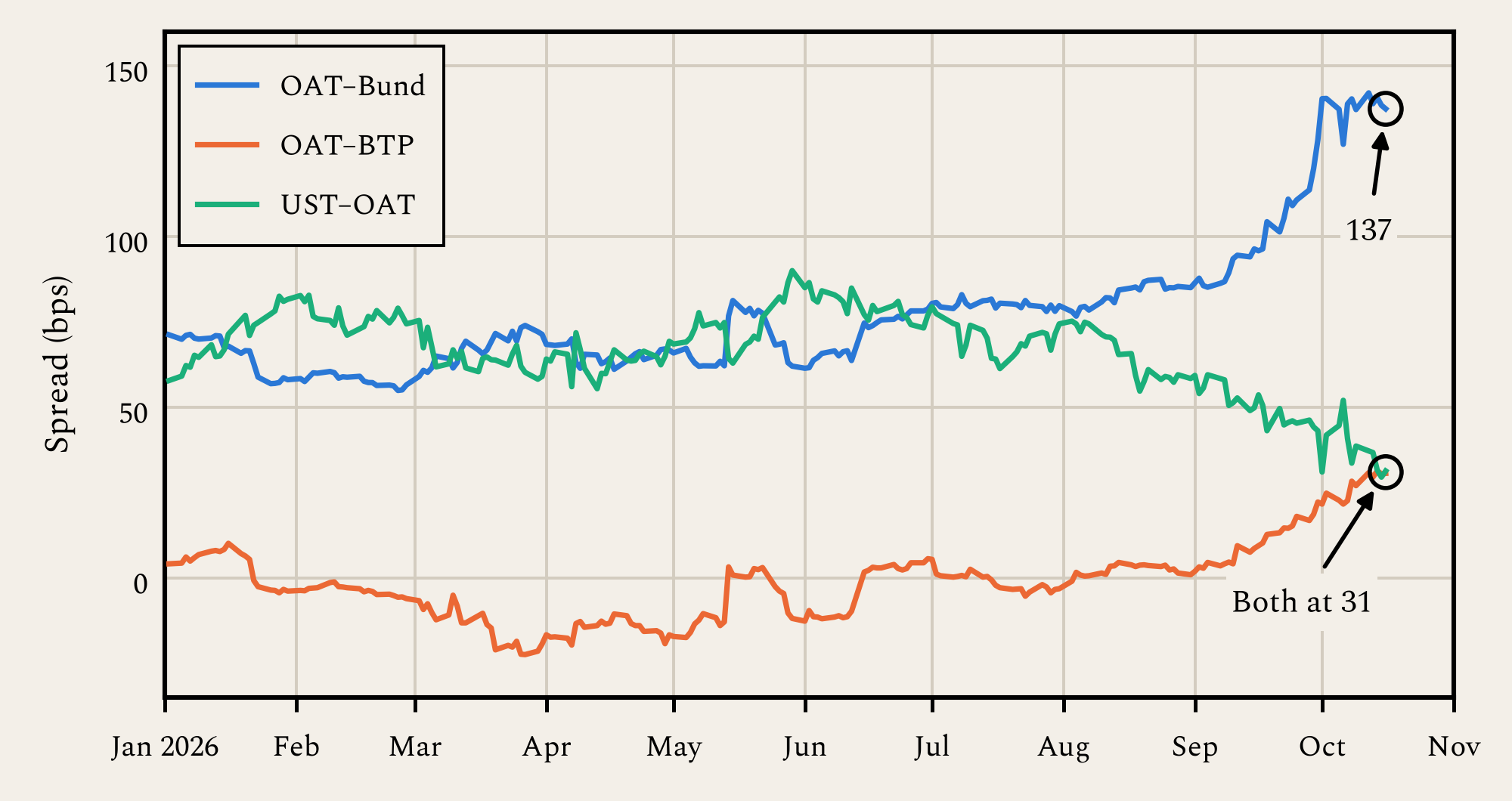
France’s sovereign spreads to Germany have widened materially since early August, while to a lesser extent against the US and Italy (see chart below). What has been causing this widening, and where do we go from here? This is mainly a story about France’s fiscal budget and politics. In our central scenarios, we expect a tightening in OAT-Bund to 130bps into year-end, and a widening to 180bps going into the presidential election in April.
The French story:
France has had no parliamentary majority since Macron called a snap election in June 2024. Two governments have fallen in Parliament since, and the last two budgets were only adopted in February, forced through the National Assembly without a vote under Article 49.3 of the Constitution. Both times, Parliament had to pass an emergency law (loi spéciale) in December to keep the state funded. Since 2023 France has been targeting a 5% yearly budget deficit but has missed it every time (see table below).

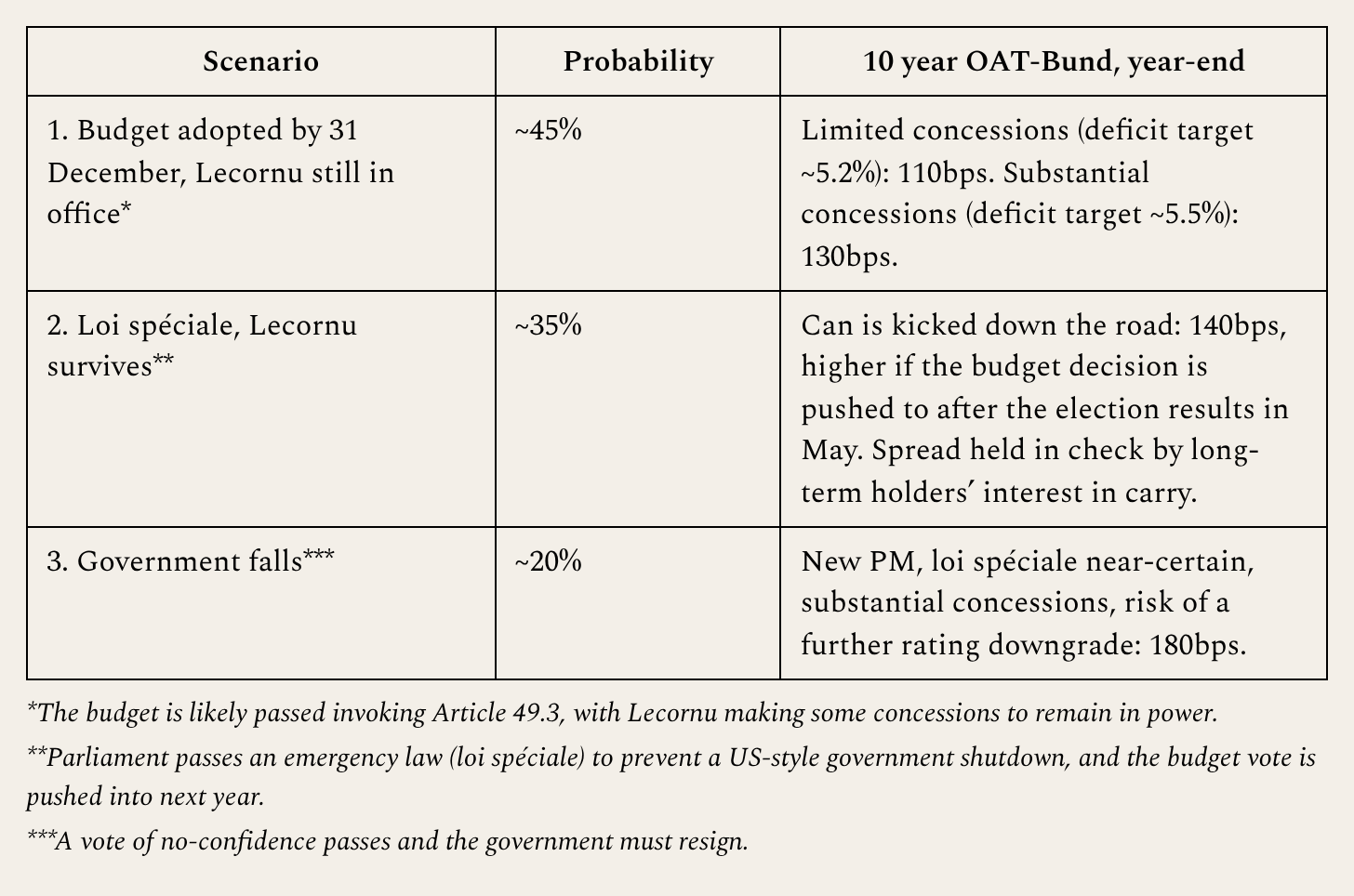
Prime Minister Sébastien Lecornu now has to pass €43bn of new savings (€54bn including measures already decided), for France to meet its 5% target next year. Parliament has until 31 December to adopt the budget. If it fails, it will again have to pass an emergency law to avoid a US-style government shutdown. All of this is happening six months before the French presidential election, in which the far-right candidate Marine Le Pen leads the polls. Markets are already pricing in the high likelihood of a miss in next year’s budget deficit target (with many estimates around 5.5%). The miss would mainly come from growth assumptions which are too optimistic, more debt that needs to be serviced as a result of higher yields, and the possibility that savings measures are diluted or delayed in Parliament. We see three main scenarios that could play out with regards to the budget and what it means for OAT-Bund spread in the near term, see table below.
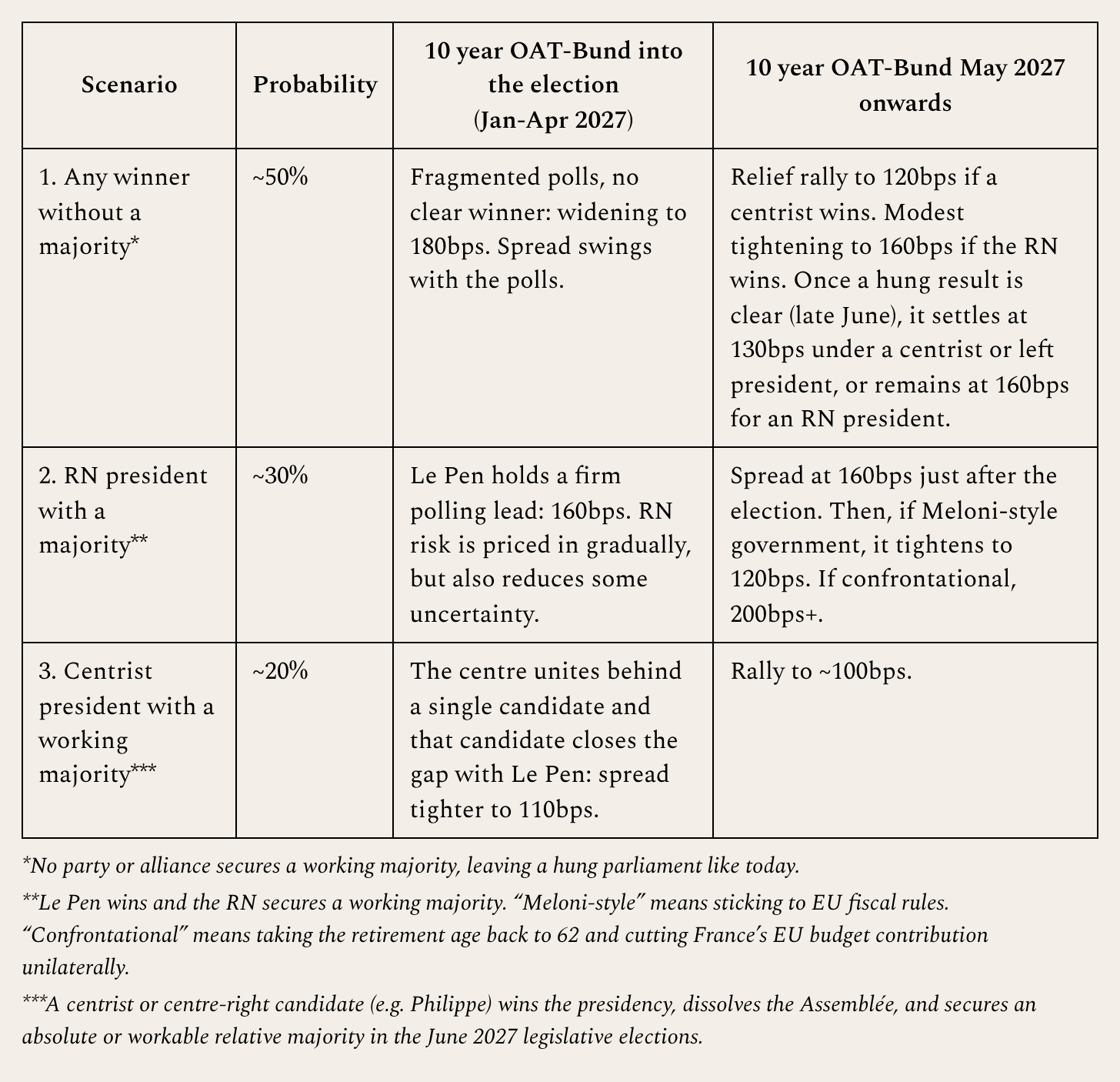
Regarding the presidential elections, prediction markets now give Le Pen about a 47% chance of winning. While she has promised €140bn of savings by 2032 and a deficit of 3% by 2030, she has also been promising to lower the retirement age to 62 (currently 62 and 9 months), alongside a €20bn tax cut, without saying how she would pay for either. So the market has been left wondering how far to believe her plans to bring the deficit down. Similarly to the budget, we see three main scenarios for how the presidential election could play out (see table below).
Germany is now a safe haven:
It’s interesting to note that since August OATs have widened against Germany by 15bps more than against the US. With the latter also facing pressure over the budget deficit and mid-term elections, investors have turned to Germany as a safe haven. Investors’ flight to quality to Germany has therefore prevented UST-OAT spreads from widening even further. We expect Germany to retain this status, therefore keeping UST-OAT spreads more contained than they would otherwise be.
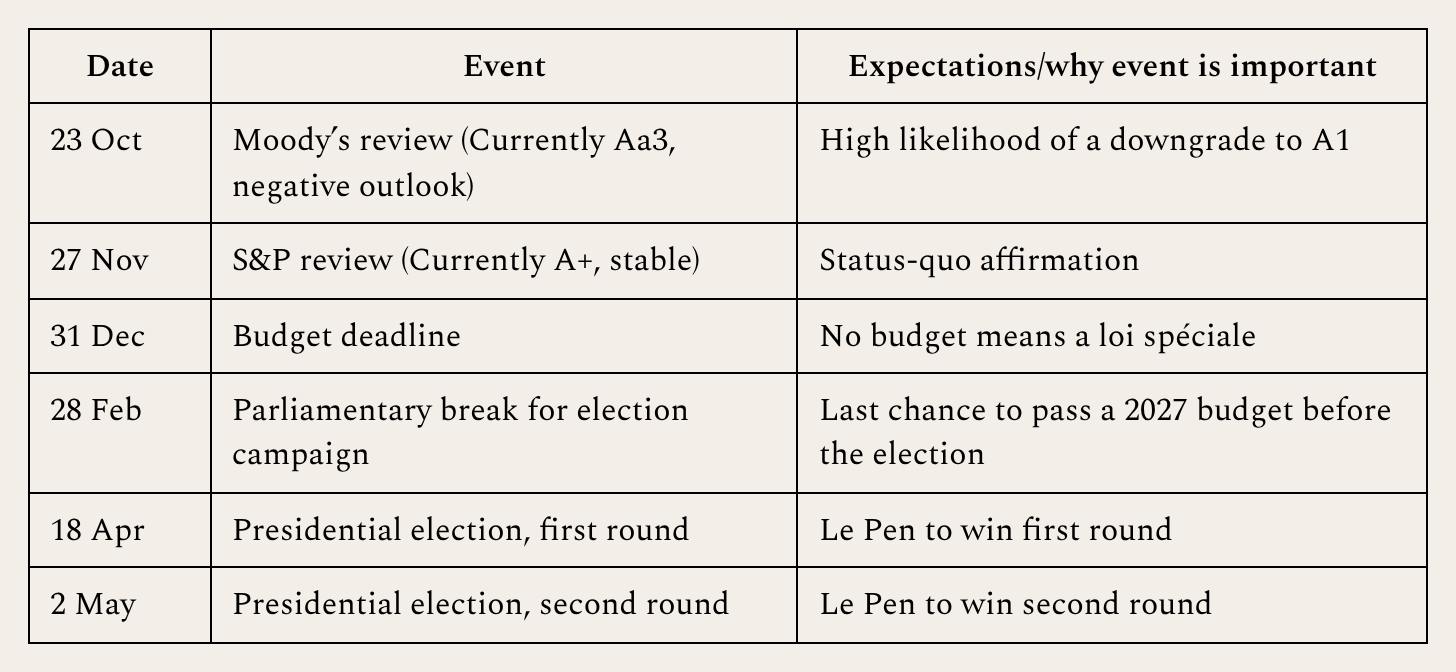
Key upcoming events in France to watch out for:
Conclusion:
While the current political and economic situation in France remains chaotic and highly volatile, in our central year-end scenario we expect the OAT-Bund spread to tighten to 130bps. This would likely come from PM Lecornu invoking article 49.3 to pass the current budget while making some substantial concessions to remain in power. In this scenario, next year’s budget deficit would drift towards 5.5%. Meanwhile, we expect a widening in the spread to 180bps in the run-up to the presidential election, as polls could remain fragmented and risks of an RN presidency with a confrontational stance run high.
If you enjoyed this article and found it insightful, subscribe for free below.