

Las Vegas, August 2006
A young couple sat across from a Countrywide loan officer to discuss mortgage options for their dream home. The officer briefly glanced at their financial records and credit scores, then handed them a set of paperwork to sign. “Good news, you are eligible for an adjustable-rate mortgage requiring zero down payment”, he said happily. He explained that for the first two years, they would pay an exceptionally low rate. By the time the initial ‘teaser’ period expired, an increase in their home value would allow them to easily refinance into another loan with a low rate.
Across the country, millions of Americans took out these kind of mortgages, also called subprime given their risky nature. But what they could not see was that the real estate sector and wider financial system were built on a highly-leveraged house of cards that relied on one assumption: house prices had to keep increasing.
It all started with the Fed cutting interest rates to 1% following the 2001 dot-com crash. On the one hand, this made buying a home much more affordable, while on the other it made investor returns on traditional safe investments very low. Hungry for yield, institutional investors began chasing riskier assets, and subprime loans were the main answer.
Investment banks eagerly bought up these mortgages from lenders, bundled them into mortgage-backed securities, and repackaged the riskiest loans into collateralized debt obligations. Credit rating agencies, paid by the very banks seeking the rating, put AAA-ratings so that even the most risk-constrained investors could buy them. Crucially, banks did not just sell these products to investors, but were holding a large chunk themselves using borrowed money.
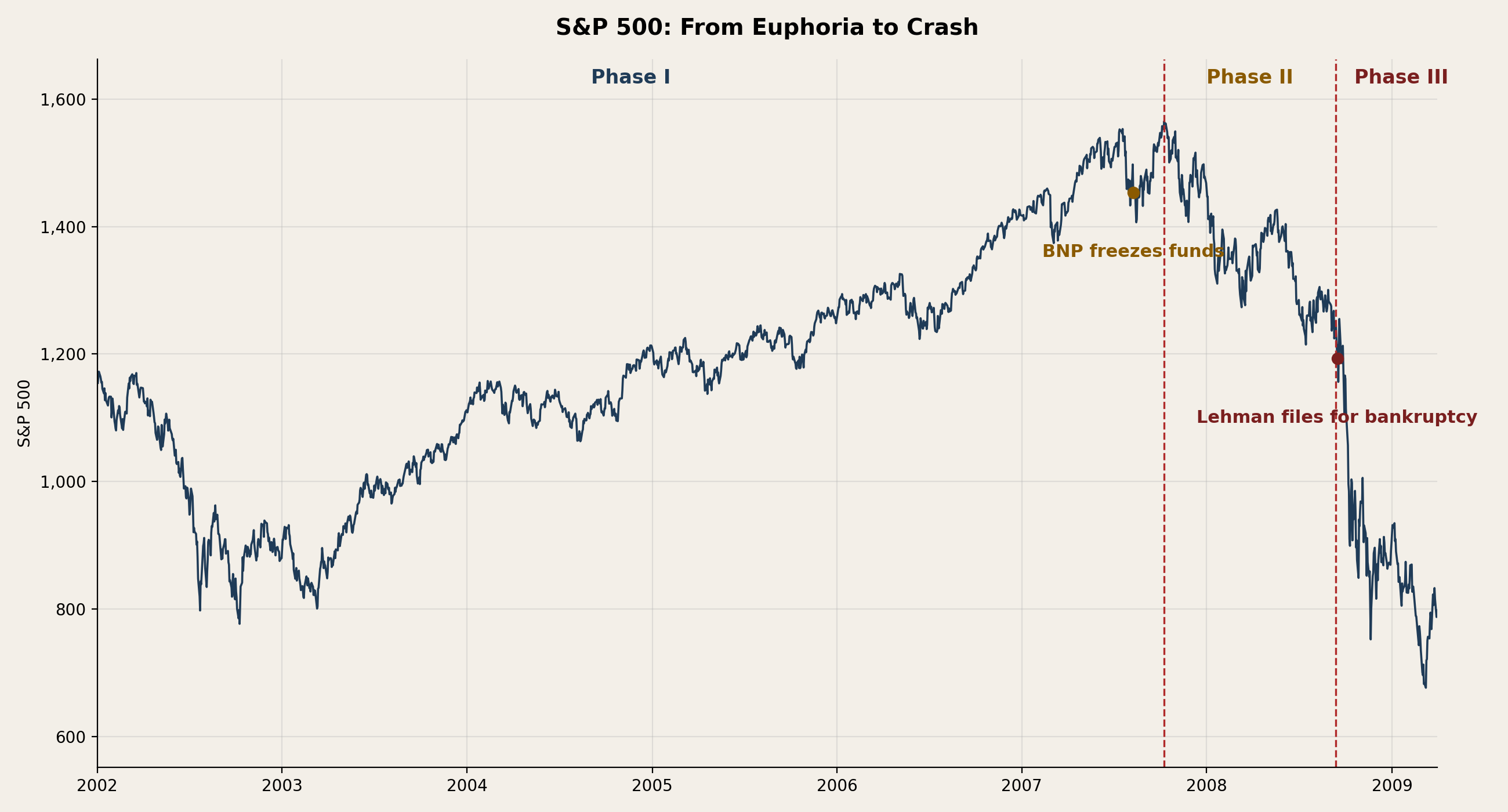
It was a free for all: consumers could afford to purchase homes that they would otherwise be unable to, while banks and investors could get high, and almost entirely risk-free returns. Between 2003 and late 2007, the S&P 500 doubled, fuelled by cheap credit and record bank profits (Phase I in the chart).
Finally, when the Fed raised rates above 5% in July 2006, housing demand stalled and home prices reached a peak. Banks largely dismissed it as ‘soft landing’ instead of a warning sign, and the S&P 500 continued to rise. But when a year later the teaser rates on the millions of subprime mortgages expired, the house of cards started to crumble. Homeowners, unable to pull the usual refinancing trick, were hit by huge payment increases which they couldn’t afford.
A rolling wave of defaults hit the market, causing bank losses so severe that in August 2007 BNP Paribas suddenly froze three of its investment funds. It later admitted it had no idea what its subprime assets were actually worth. Though equities briefly rallied to a new peak in October, underlying credit markets came to a halt. Banks across both sides of the Atlantic stopped lending to one another fearing that their peers were sitting on billions in toxic mortgages. They also stopped lending to businesses and consumers, triggering a severe recession in the US and a large correction in the S&P (Phase II in the chart).
Conditions continued to deteriorate in 2008, but major banks still operated under the belief that the government would step in to save any institution that was deemed “too big to fail”. On September 12, with Lehman Brothers on the brink of collapse, these expectations were about to change.
The Chief Executive Officers of the most powerful banks met in the Fed’s boardroom to address the imminent bankruptcy of Lehman Brothers. “The US government will not intervene,” said Treasury Secretary Henry Paulson. “If Lehman is to be saved, the men at this table will have to save it themselves, with their own capital, by Sunday night.” A murmur of panic and confusion emerged among those participating, as they all thought the government would come to the rescue just as it did with Bear Stearns six months earlier.
While Bank of America and Barclays briefly emerged as potential saviours, the former pivoted to buy Merrill Lynch instead. Barclays worked out a rescue plan, only for British regulators to strike a fatal blow by refusing to approve the deal without a shareholder vote. With no buyers left and the clock running out of time, Lehman’s board met again and, after a long discussion, decided to file for bankruptcy protection. It was the largest failure in American history, with total assets over $630 billion.
By early morning on Monday, a sea of reporters and TV cameras stood outside Lehman’s headquarters, broadcasting the bankruptcy in real time. Employees left the building carrying cardboard boxes, gym bags, and any other of their belongings. The S&P 500 dropped 5%, led by large losses in bank stocks (Phase III in the chart).
The next day, panic spread to one of the nation’s oldest and largest money market funds, the Reserve Primary Fund. It held roughly $750 million in Lehman Brothers’ short-term debt, which was now worthless. Investors rushed to withdraw tens of billions in just two days, triggering a wider run on money market funds. “You faced the prospect of some of the largest companies in the world and the United States losing the capacity to fund and access those commercial paper markets,” the President of the New York Fed later noted. Both banks and corporates relied heavily on these loans to conduct daily operations, and they were now facing a terrifying reality: they might be unable to pay their employees.
The financial sector descended into disarray as investors fretted over who would be the next Lehman. Morgan Stanley, Washington Mutual, and Wachovia’s shares all tanked over 40%, while Goldman Sachs 20%. Treasury Secretary Paulson and Fed chair Bernanke rushed to Capitol Hill for a closed-door emergency meeting with Congress. In a document of only three pages, they outlined the details of the Troubled Asset Relief Program (TARP), designed to purchase up to $700 billion in toxic assets from financial institutions. “If we do not do this, we may not have an economy on Monday,” said Bernanke.
Even when the bill passed two weeks later, the economy could not wait months for its deployment. With time running out, the Fed chair invoked emergency powers and started buying short-dated debt from corporates and financial institutions to keep them afloat. He also coordinated a global 50-basis-points rate cut to ease borrowing conditions and restore lending.
Meanwhile, Paulson summoned the CEOs of Wall Street’s nine largest banks and handed them a brief document outlining a non-negotiable deal: the US government was taking direct equity stakes in their firms, injecting $125 billion of public capital. He made it clear no one was leaving until everyone signed. “We are doing this for the good of the system”, he said.
The drastic emergency measures successfully prevented total collapse of the global banking system, but they could not stop the economic damage already set in motion. Over the coming months, millions of workers lost their jobs and their homes, GDP contracted sharply, and the S&P continued to fall. It found a bottom in March 2009, 57% down from its peak a year and a half earlier.
The events leading up to, and the unfolding of the crisis itself, also fundamentally altered present-day markets. The Fed crossed into uncharted territory, bringing interest rates down to 0% and injecting trillions through various rounds of quantitative easing to restore lending. It prevented the US from entering a deflationary spiral but artificially increased stock and housing prices, and made the financial system reliant on a high level of excess liquidity. Debates are still ongoing on whether, and to what extent, can this be reduced. Meanwhile, banks were mandated to hold far higher levels of liquidity and capital reserves, while being subjected to annual stress tests to ensure they could survive future shocks. The result was a significantly healthier and better-capitalized banking system. To this day, the mechanisms and systemic failures of 2008 remain deeply studied by economists, regulators and historians. The sheer scale of its consequences worldwide earned it the title of Global Financial Crisis.
If you enjoyed this article and found it insightful, subscribe for free below.