

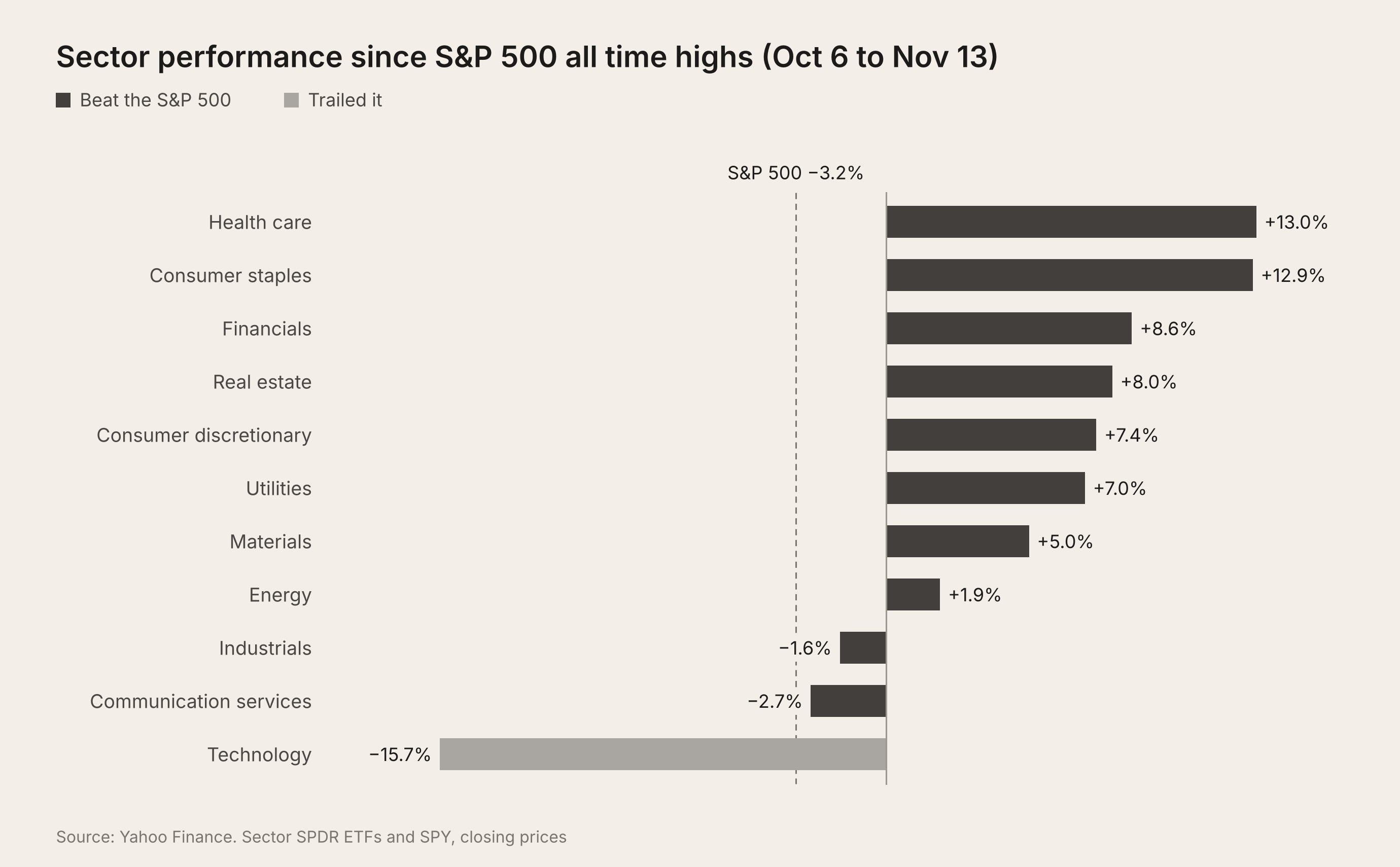
As shown in the chart below, since the S&P 500 reached its peak in early October there has been a rotation out of tech and into other sectors, most notably in health care. In the sections that follow, we will delve deeper into which healthcare companies are on our watchlist and why, and how each is integrating their workflows with AI.
The Watchlist
Roche
Roche is a Swiss healthcare group with two main divisions: Pharmaceuticals, which includes the US biotech Genentech, and Diagnostics, one of the world’s largest testing businesses.
Strengths:
Earnings visibility: In each of the last five years Roche met or beat the sales guidance it gave in January. Its revenues are also well diversified, with no product accounting for more than about 12% of group sales.
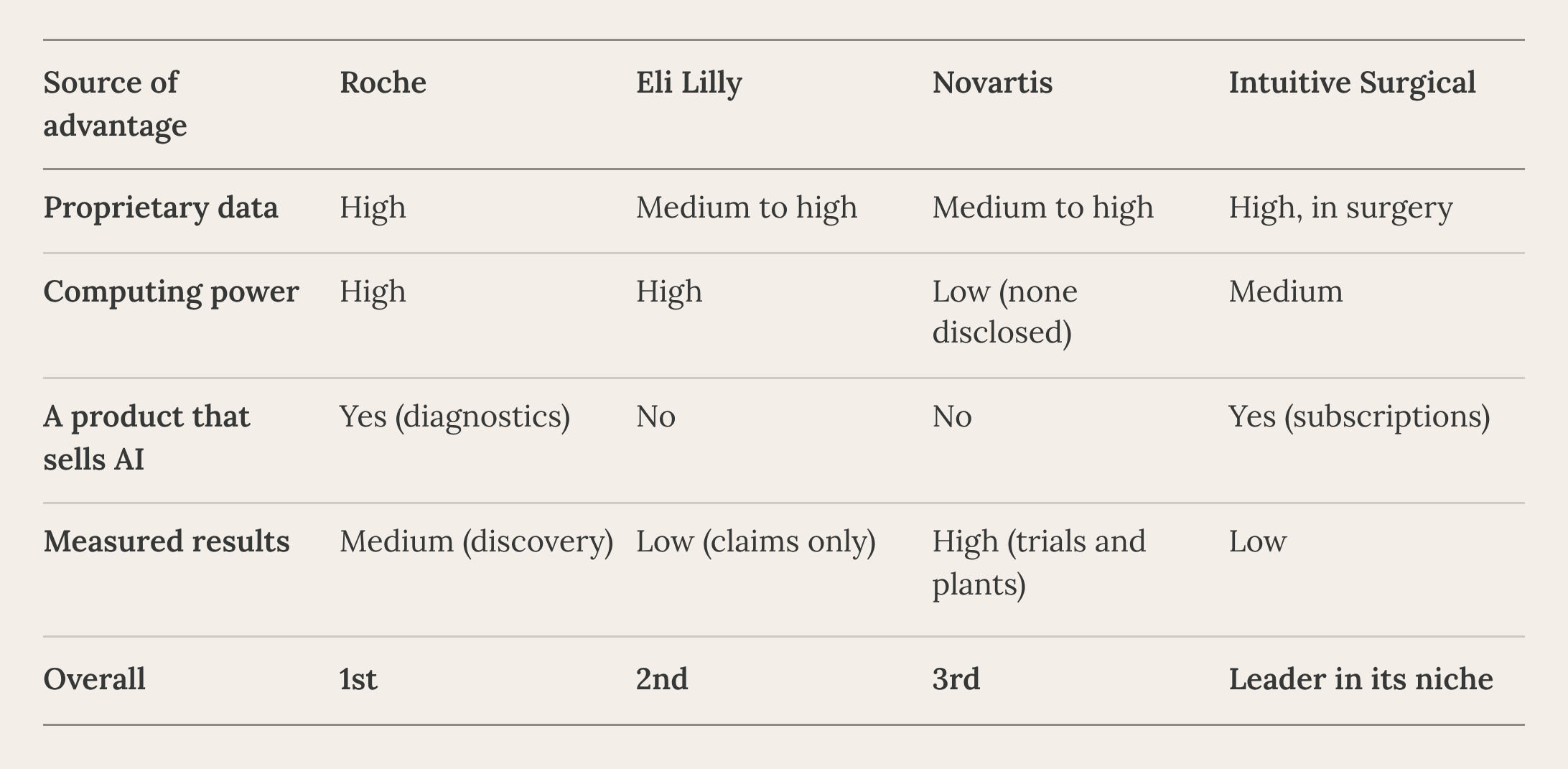
Adoption of AI: Roche operates more than 3,500 Nvidia GPUs, the largest in the industry. It incorporates AI deeply in its business units (eg. drug research, site selection, reducing administrative cost) and it sells AI-based products through its diagnostics division.
Low policy risk: Roche’s US pharmaceutical imports are tariff-free until January 2029.
Pipeline: Six drugs are due for FDA approval decisions by July 2027. Notable drugs to watch out for include giredestrant (breast cancer, decisions on 30 November and 18 December 2026) and fenebrutinib (multiple sclerosis, around March 2027, est.).
Key Risks:
Pipeline setbacks and a late start in obesity: The Phase III trials behind giredestrant (for breast cancer) and fenebrutinib (for multiple sclerosis) are finished and positive, but the FDA could still delay, restrict or reject them. Additionally, Roche’s weight-loss drugs are years behind the market leaders, so it may win only a small share of that market.
Biosimilars: A Biosimilar is a highly similar, equally safe, and lower-cost version of a product. Roche faces intense competition from biosimilars, especially for its fastest growing product, Xolair (used to treat allergic conditions). As a result, outside the US, Xolair sales fell 25% in Q3.
Novartis
A Swiss pure-play innovate-medicines company, having spun off its generics arm (Sandoz) in 2023.
Strengths:
The patent cliff is behind it: Entresto, its largest product, lost US exclusivity (patent protection) in July 2025. Its share of group sales has since fallen from about 15% to 8%. The brands that will drive growth have US exclusivity: Cosentyx until 2029, Kisqali and Kesimpta until 2031, Zolgensma until 2033, Pluvicto, Leqvio and Fabhalta until 2034 and Scemblix until 2035. Together, they accounted for half of group sales in the first nine months of 2026, and they still have room to grow.
Solid growth in oncology: Oncology is 31% of sales and grew 30% in the first nine months of 2026.
Key Risks:
US price negotiation hits Cosentyx, Kisqali and Xolair: From 2028, the US government’s Medicare programme will pay a lower, government-set price for Cosentyx, Kisqali (which together account for about 25% of sales) and Xolair (which accounts for roughly 3% of sales). This could reduce Novartis’ revenue from 2028 by about 1-2%.
Costly acquisitions: Novartis buys much of its pipeline ($15.5bn of acquisitions in the first nine months of 2026), and two late-stage bets failed in September 2026 (costing an estimated $3.6 billion in potential annual sales). Net debt has risen to $37bn, and Artisan Partners, a top shareholder, is demanding changes to the board and to how deals are made.
Eli Lilly
Eli Lilly is a US pharmaceutical company, now focused on diabetes and obesity, oncology, immunology and neuroscience. Its current growth comes mainly from the weight-loss and diabetes drugs Mounjaro and Zepbound, which have made it the largest healthcare company by market value.
Strengths:
Growth has further to run: Medicare began covering obesity drugs in July 2026, and Lilly’s monthly prescriptions rose almost 3x from July to September.
Market leadership protected to 2036: Lilly has 63% of US weight-loss and diabetes prescriptions against Novo Nordisk’s 37%, and Mounjaro and Zepbound grew strongly in the third quarter. The tirzepatide compound patent runs to 2036 in the US and 2037 in Europe.
Key Risks:
Concentration in one drug class and in the US: Most of Eli Lilly’s growth comes from weight-loss drugs, so a safety issue, a competitor with better data, or faster-than-expected price erosion in obesity would hit sales and earnings hard. Additionally, 2/3 of Lilly’s revenues come from the US, leaving it far more exposed to changes in US healthcare policy than Roche or Novartis.
Competition and pipeline risk: Novo Nordisk, and a wave of new oral and injectable obesity drugs from other companies, are targeting the same market.
Intuitive Surgical
Intuitive Surgical is a US medical-device company that makes the da Vinci robotic surgery systems and the robotic lung-biopsy platform. It earns most of its revenue (roughly 85%) from recurring sales of instruments, accessories and services tied to a large installed base, with the systems themselves a smaller share.
Strengths:
Dominant installed base: Over 12,000 da Vinci systems are installed (+12% YoY), more than 20 million procedures have been performed on them, and 84% of revenue is recurring.
Durable growth, and strong balance sheet: Revenue grew 15% a year from 2021 to 2025, it currently has $6.8bn of cash, no debt, and bought back $2.9bn of shares in Q3.
Technology and data lead: da Vinci 5 has over 2,000 systems installed and is cleared in the US, EU, Japan, Korea, India and Brazil.
No exposure to drug-pricing policy: Deals that tie US drug prices to the lower prices paid abroad, and Medicare’s price negotiations do not apply to surgical robots.
Pipeline: Notable items to watch out for include da Vinci 5 in China and telesurgery, neither with a timeline.
Key Risks:
New competition and pricing pressure: Although still in early phase, rival robots from Medtronic and Johnson & Johnson are arriving after Intuitive’s core patents expired.
Slowing procedure growth: Growth has slowed, evidenced by the shares being 21% down year-to-date. A further slowdown, especially in mature procedures like general surgery would further hit revenue.
Valuation: Current share price is at 38x forward earnings, so a miss on procedure volumes or margins could cause a sharp drop.
Metrics and Valuation
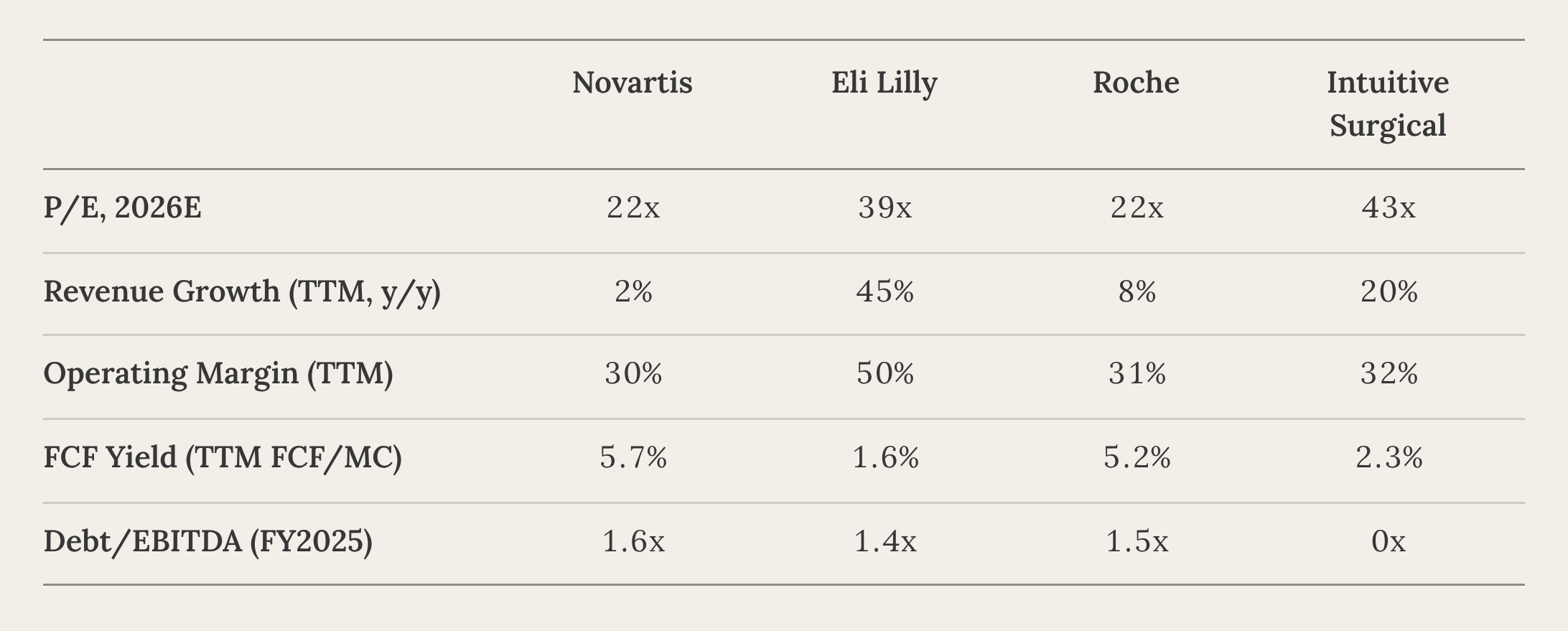
Lilly carries the richest multiple of the group, while Novartis and Roche look fairly valued after recent gains.
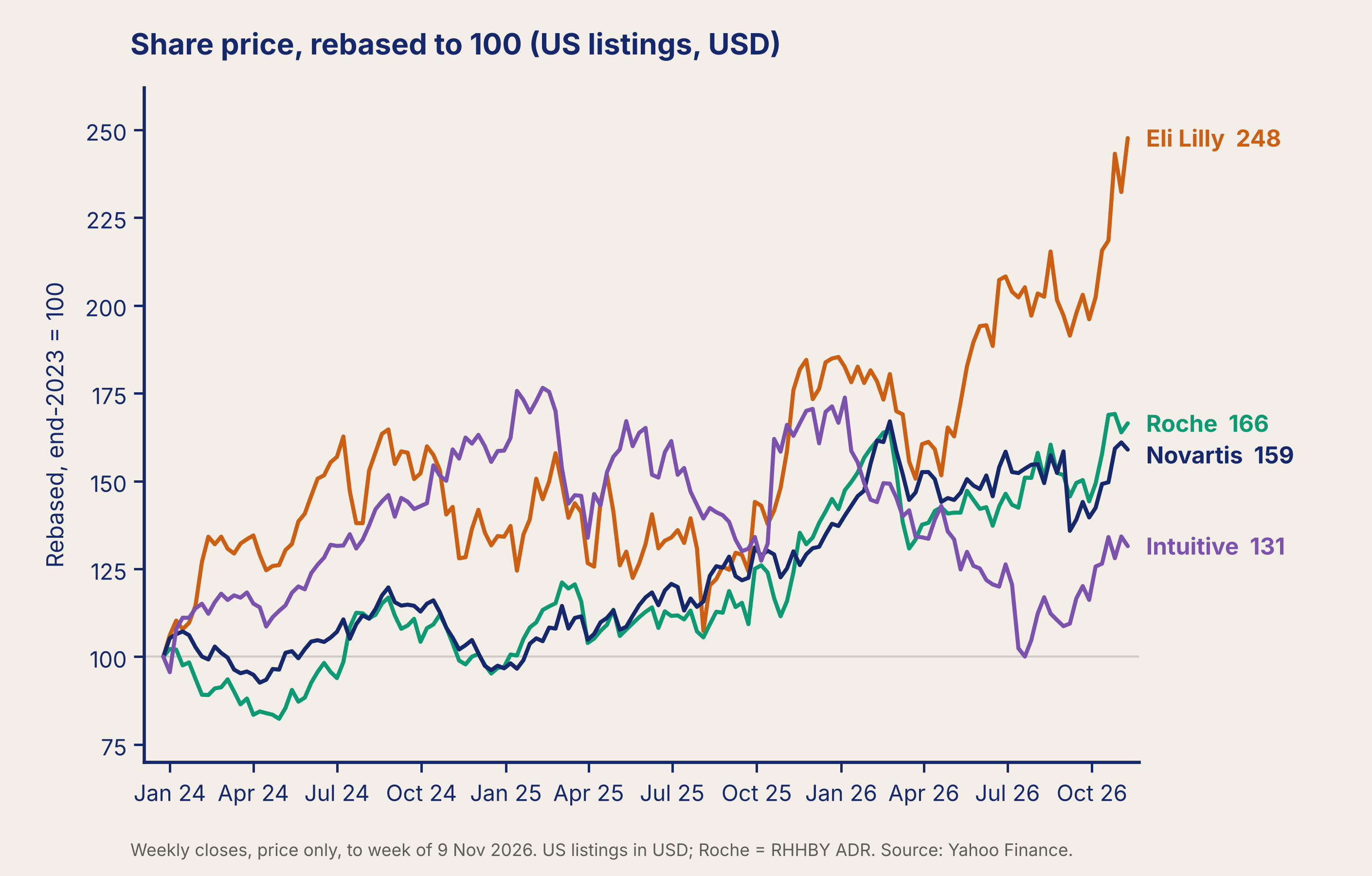
In terms of performance over the past three years, Eli Lilly has clearly been the outperformer, driven primarily by Mounjaro (weight-loss).
Roche and Novartis remain bellwethers in the Healthcare industry and largely tracked the sector as a whole (while making up a large proportion of it from a market capitalisation perspective). Intuitive Surgical has been more volatile during the course but overall performance was in-line.
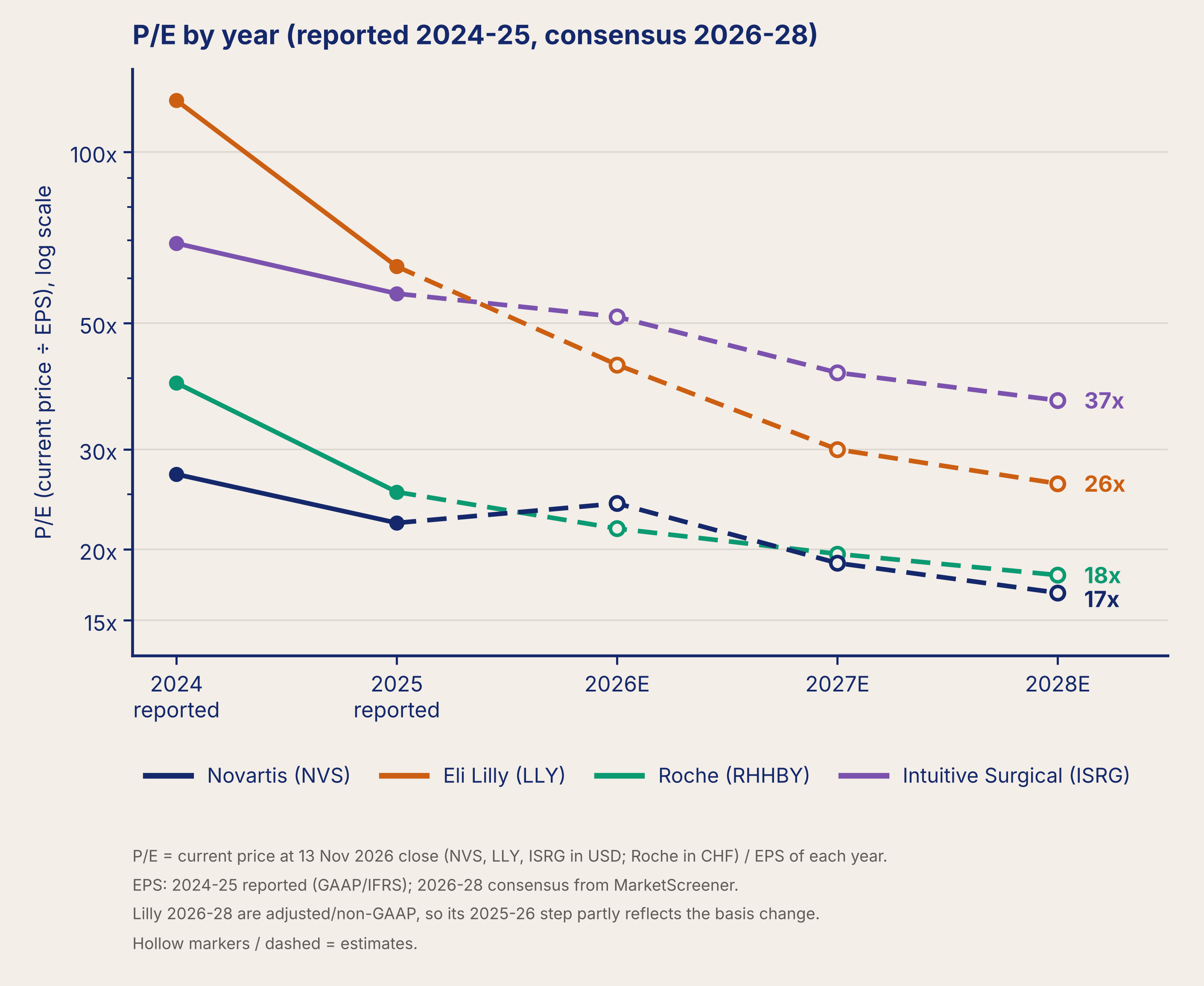
Looking optically at the P/E ratios, it appears that ratios have recently been high, both relative to Healthcare and S&P 500 historical values, and are returning more to previous levels over the next few years and earnings increase rapidly.
The historical P/E ratios for the Healthcare sector over different timeframes:
(i) 1-year average: 27
(ii) 5-year average: 25
(iii) 10-year average: 21
(iv) 20-year average: 18
Clearly, when considering the above and looking at the recent and forward-looking P/E estimates, for Healthcare to return to the mean while negating any price fall in equity markets, then EPS must increase significantly. This is particularly important for the likes of Intuitive Surgical and Eli Lilly.
AI in healthcare
There are three main ways in which AI can find applications in healthcare:
As a cost tool, AI makes existing work cheaper or faster: writing documents, choosing trial sites and inspecting vials.
As a pipeline engine, AI helps find better drugs, or find them faster. This is the largest prize, but drugs take 8–10 years to reach the market, so it pays mainly in the 2030s.
As a product, AI is built into something a company sells: a diagnostic test, a surgical robot, a personalised vaccine.
AI is already measurable in imaging and administration, while promising but unproven in drug approvals.
How is each company using AI?
Diagnostics and imaging: Roche sells AI through its diagnostics business, while Intuitive has two FDA-listed AI products, both turning CT scans into 3D models before surgery. Lilly and Novartis have no diagnostics business.
Administrative cost: All, except for Intuitive, utilise AI for writing reports, regulatory documents, in calls and sales centres. They all report large savings in number of hours worked.
Clinical trials: All, except for Intuitive, utilise AI for selecting sites and to find trial patients.
Drug discovery: Roche uses AI in about 90% of eligible small-molecule programmes and said it designed one molecule 25% faster. Lilly uses over 1,000 supercomputers and has a dedicated platform for drug discovery. Novartis has made a number of partnerships, including with Isomorphic Labs, Generate Biomedicines, Profound Therapeutics and Relation Therapeutics.
Surgical robotics: Intuitive is the only one that operates in this field. It has over 20 million recorded procedures and video analysis after operations which are sold by subscription. Telesurgery clearances are expected in 2028.
Who is best positioned to benefit from AI?
If you enjoyed this article and found it insightful, subscribe for free below.